Duluth is a city defined by its rugged beauty, steep hills, and distinct architectural history. From the stately manors of the East End to the sturdy bungalows of the West, our homes tell the story of a city built to last. However, even the sturdiest structures face the inevitable test of time and weather. For homeowners in Duluth, the reality of an aging housing stock is becoming impossible to ignore, particularly when we look upward.
As we approach 2026, a significant portion of the city’s residential roofs are reaching the end of their functional lives. This article explores the current state of Duluth’s housing landscape, analyzes the age of our homes, and projects the upcoming wave of roof replacements necessary to protect our community’s most valuable assets.
Introduction to Duluth’s Housing Landscape
Duluth’s housing market is unique, shaped heavily by the geography of Lake Superior’s shores and the bedrock bluffs that define the city’s layout. Unlike many suburban communities that saw massive expansion in the 2000s, Duluth’s residential core is deeply rooted in the past.
The city’s housing stock is historically significant and heavily weighted toward older construction. According to recent data from the City of Duluth’s comprehensive housing needs analysis, an estimated 43% of all housing units in Duluth were built prior to 1940. This is a stark contrast to surrounding First-tier cities and townships, where only 14% of homes date back that far.
Following the pre-war era, the city saw another active period of development. Approximately 30% of Duluth’s housing stock was built between 1950 and 1979. This mid-century boom added over 12,000 units to the city, creating the neighborhoods many of us live in today.
This historical context is crucial because these homes were built to withstand the elements, but materials degrade. The unique climatic challenges of our region, like intense freeze-thaw cycles, heavy snow loads, and driving winds off the lake, accelerate wear and tear on building envelopes, with roofs taking the brunt of the damage.
Age Distribution of Homes in Duluth
To understand the scope of the roofing challenge, we must look at the numbers. The age distribution of homes in Duluth paints a picture of a city that is maturing all at once.
- Pre-1940s (43.4%): Nearly half of Duluth’s homes are over 80 years old. While many of these structures have likely seen one or two roof replacements in their lifetime, the underlying roof decking and structural components are aging.
- 1950s – 1970s (22.3%): The homes built during the post-war boom are now 50 to 70 years old. A home built in 1970 with a standard 25-year asphalt shingle roof has likely seen a replacement in the mid-90s and is now due for its third roof right about now.
- 1980s – Present: Newer construction represents a smaller slice of the pie in Duluth compared to neighboring areas.
This distribution means that the vast majority of Duluth’s homeowners are living in properties where maintenance is no longer optional, it is critical. The “deferred maintenance” often discussed in housing reports is now manifesting as leaks, ice dams, and structural fatigue.
Typical Roof Lifespans in Duluth
In the roofing industry, “typical” lifespan is a relative term, heavily influenced by local weather. In Duluth, our climate is the primary adversary of roofing materials.
Asphalt Shingles
This is the most common material found on Duluth homes.
- Standard 3-tab Shingles: Typically rated for 20 years, but in our harsh climate, they often begin to fail around year 15-18 due to wind uplift and brittleness from freezing temperatures.
- Architectural Shingles: Rated for 30-50 years. In Duluth, a realistic expectation is 25-30 years before granule loss and seal failure become problematic.
Cedar Shakes
Found on some of the historic pre-1940s homes, cedar offers natural beauty but requires high maintenance.
- Lifespan: 20-40 years, depending heavily on maintenance. Without proper care, moss and rot (accelerated by our humidity and snow) can shorten this significantly.
Metal Roofing
Increasingly popular for its durability against snow and ice.
- Lifespan: 40-70 years. While expensive upfront, metal roofs shed snow efficiently, reducing the risk of ice dams, which are a major plague for Duluth homeowners.
The “Duluth Factor”
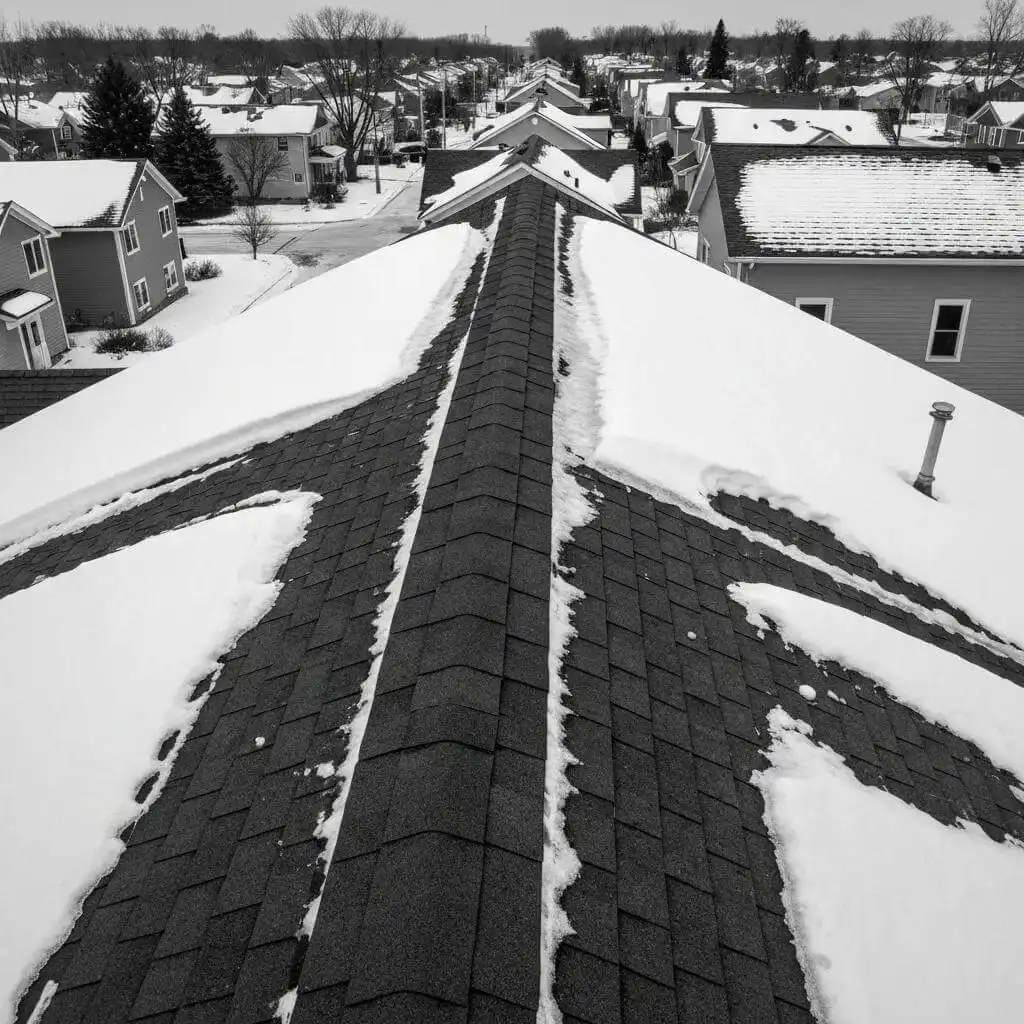
Why do roofs fail faster here? It isn’t just the cold; it is the fluctuation. A roof in Duluth might experience a 50-degree temperature swing in 24 hours during spring. This causes rapid expansion and contraction of materials, cracking shingles and popping nails. Furthermore, the sheer weight of snow accumulation on older timber structures can lead to sagging, which compromises the roof system’s integrity.
Roof Replacement Projections by 2026
Based on the housing age data and typical material lifespans, we are approaching a convergence point where a high volume of roofs will require replacement by 2026.
The 2000s Replacement Cycle:
Homes that received new roofs around the turn of the millennium (2000-2005) are hitting the 20-25 year mark. This includes the massive segment of pre-1940s homes that were renovated during the early 2000s real estate activity.
The Mid-Century Bubble:
Homes built in the 1970s (approx. 10.3% of stock) that last replaced their roofs in the late 90s or early 2000s are also entering the danger zone.
Statistical Estimation:
With roughly 38,900 occupied housing units in Duluth, and assuming a conservative 25-year cycle for the average roof:
- Approximately 4% of the housing stock needs a new roof every single year.
- That equates to roughly 1,500 to 1,600 roofs needing replacement annually.
- By 2026, we estimate that nearly 8,000 homes in Duluth will have entered a critical window for roof replacement since 2021.
The homes most at risk are the pre-1940s builds. These homes often have complicated rooflines, existing layers of old shingles (which must be removed to comply with code), and potentially deteriorating decking that hasn’t been inspected in decades.
Duluth Homeowner Roof Challenges & Perrault Construction Solutions
The data suggests a challenging few years ahead for Duluth homeowners. The “aging in place” trend means many residents are living in older homes on fixed incomes, making a $15,000+ capital improvement daunting. Additionally, the recent rise in material costs and labor shortages can make finding a contractor difficult.
Challenges for Homeowners
- Insurance Pressures: Insurance carriers are becoming stricter, often demanding roof replacements on roofs older than 15 or 20 years to maintain coverage.
- Energy Efficiency: Old roofs on old homes often equate to poor insulation and massive heat loss, which is a critical issue with rising energy costs.
- Hidden Costs: On a pre-1940s home, a “simple” re-roof often uncovers rot, requiring carpentry work that blows the budget.
Opportunities for Perrault Construction
For Perrault Construction, this data highlights a clear path to serving the community.
- Education is Key: Homeowners need to understand that a roof isn’t just shingles; it’s a system including ventilation and insulation. Educating clients on how a new roof protects their biggest investment (and lowers energy bills) is vital.
- Specialized Expertise: With 43% of homes being pre-war, there is a high demand for contractors who understand the nuances of historic structures like handling steep pitches, preserving architectural integrity, and correcting ventilation in attics not designed for modern standards.
- Financing Solutions: Offering flexible financing options, like we do, will be a game-changer for homeowners facing unexpected replacements.
The aging homes of Duluth are a testament to our city’s resilience. By acknowledging the lifespan of these structures and planning for the inevitable replacements, we ensure that Duluth’s neighborhoods remain safe, beautiful, and standing tall for the next generation.
Data sources: City of Duluth Comprehensive Housing Needs Analysis (2025).